
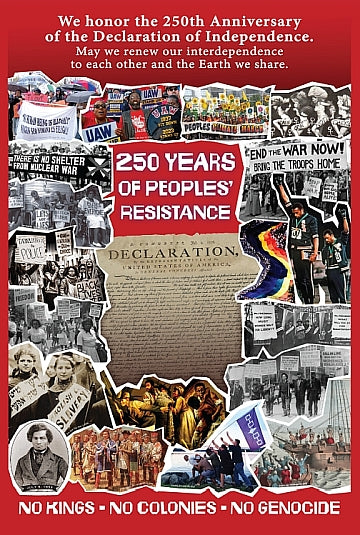
Postcard - 250 Years of Peoples Resistance
Postcard - 250 Years of Peoples Resistance
SKU:T319CWD
| Quantity | Discount |
|---|
Couldn't load pickup availability
Dimensions: 4" x 6"
The 250 Years of Peoples’ Resistance poster and postcard was developed and produced by the Creative Team at Syracuse Cultural Workers, with lots of support from Tom Kerr and inspiration from Matt Meyer of the Spirit of Mandela Coalition, which is organizing a national Mobilization Against Genocides in Atlanta on July 4, 2026.
The postcard is available for purchase here or as a free download for activist organizations to use to promote events related to the 250th anniversary of the United States Declaration of Independence.
Below is background information about each of the images included in the poster, including artist credits. All of the images are either public source or the artists generously donated the use of their work to support this project. The images are described starting in the upper left corner and continuing clockwise.
No Human Being is Illegal March
Immigrants’ Rights Protest in Syracuse, New York, April 22, 2006. One of hundreds of protests across the country demanding full human rights for immigrants regardless of documentation status. Twenty years later U.S. Immigration and Customs Enforcement (“ICE”), empowered and bloated by the Donald Trump administration and Congress with the passage of the Orwellian named “The One Big Beautiful Bill," has greatly escalated the cruel repression. Photo: Syracuse Peace Council
Syracuse, NY—April 22, 2006
UAW Strike
United Auto Workers (UAW) in 2023 during its strike against the three major U.S. automakers—Ford, General Motors, and Stellantis. This successful strike led to significant wage increases, reinstated cost-of living adjustments, the elimination of “wage tiers,” and the right to strike over plant closures. It also produced what was called a “UAW Bump,” leading most non-unionized automakers to also increase wages, mainly to undermine unionization efforts at their plants. Photo: Jim West ©2023
Detroit, MI—Sept 15, 2023
Peoples Climate March
The People's Climate March in New York City, September 21, 2014, was the largest climate protest up to that point. An estimated 400,000 people marched in Manhattan alone, while hundreds of thousands more gathered in over 2,500 events worldwide. Intended to prompt bold action by world leaders, the march took place days before a momentous United Nations climate summit. The movement continues. Photo: Jim West ©2014
New York City—September 21, 2014
Feminist Graffiti / Truth in Advertising
Billboard for Harrah's, the famous Las Vegas hotel and casino, altered by second-wave feminist graffiti, transforming a group of “showgirls” into feminist activists. This and other similar altered corporate marketing subversion was a tactic designed to disrupt dominant patriarchal discourse. Nonviolent direct action has played an important role in social movements throughout history. Billboard Enhancement: War Resisters League West
San Francisco, CA – c.1979
End the War Now: Vietnam Protest March
Banner held high at the front of an antiwar march on the University of Michigan campus on September 20, 1969. By this stage of the Vietnam war, students across the country had galvanized opposition to the war. On October 15, an estimated two million people across the U.S. participated in teach-ins, rallies, and candlelight vigils. On November 15, half a million people gathered in D.C. for the largest anti-war rally in U.S. history. Photo: Courtesy of The Detroit News Collection, Walter P. Reuther Library (Archives of Labor and Urban Affairs)
Ann Arbor, MI—September 20, 1969
Black Power at the Olympics
American sprinters Tommie Smith and John Carlos raised their black-gloved fists during the playing of the U.S. National Anthem at the 1968 Summer Olympic Games in Mexico City. Smith raised his right fist to represent Black power and wore a scarf for Black pride. Carlos (on the right) raised his left fist to represent Black unity and wore beads to honor victims of lynching. Their brave demonstration brought world-wide attention to racism in the United States and the Black Power Movement.
Mexico City—October 16, 1968
Stonewall Rainbow Flag
Rainbow flag unfurled and carried in the streets of New York City on June 26, 1994, by an estimated 5,000 to 10,000 volunteers, who were commemorating the 25th anniversary of the 1969 Stonewall Riots. The flag was designed by Gilbert Baker, creator of the original 1978 rainbow pride flag.
New York City—June 26, 1994
Women’s Suffrage Protest
A protest by the “Silent Sentinels,” a group of over 2,000 women organized by Alice Paul and the National Woman's Party (NWP) in front of the White House on “College Day” in 1917. The women wore sashes representing their alma maters to demonstrate that educated women across the country demanded the right to vote. The group gathered at the White House to highlight President Woodrow Wilson’s failure to support women’s suffrage. Scores of the protesters were arrested and some forcefed in prison as part of the campaign. A year later, Wilson relented. It took 72 years of activism for women to win the right to vote in the United States. Library of Congress
Washington, DC—February 1, 1917
Parade of Unemployed
The "Parade of Unemployed" was a public demonstration in New York City held on May 31, 1909. The diverse group of men in the photo are protesting the widespread unemployment that followed the Panic of 1907, a panic which culminated in both a stock market collapse and bank runs that produced a nationwide recession. Library of Congress
New York City—May 31, 1909
Boston Tea Party
“Destruction of Tea at Boston Harbor,” a hand-colored lithograph (circa 1840-1850), shows colonists organized by the Sons of Liberty and disguised as Mohawk Indians dumping chests of tea into the Boston Harbor to protest a British import tax on the tea. The colonists objected to taxation without representation by the British Parliament, which levied the tax to bolster revenue for the East India Company. The action was part of broader boycotts and refusals to pay taxes as part of the movement to oppose British control, leading to the Revolutionary War. Library of Congress
Boston, MA—December 16, 1773
Haudenosaunee Flag Raising
Haudenosaunee Confederacy flag raising during the 2013 Two Row Wampum Renewal Campaign—a major educational and advocacy campaign organized by the Onondaga Nation and Neighbors of the Onondaga Nation to commemorate the 400th anniversary of the first treaty between the Haudenosaunee and European settlers. The campaign centered treaty rights and environmental protection, seeking to bring to life the powerful vision embedded in the Two Row Treaty. The allusion to the Iwo Jima flag raising demonstrates both Haudenosaunee irony and underscores the sacred nature of the centuries-long effort to restore Haudenosaunee land rights. Photo: Gwendolen Cates ©2013 for the Two Row Wampum Renewal Campaign
Catskill, NY—July 30, 2013
Harriet Tubman’s Underground Railroad
"Harriet Tubman's Underground Railroad” depicts abolitionist Harriet Tubman armed and leading a group of enslaved people through woods as they escape toward freedom. Formerly enslaved herself, Tubman’s determination and courage led to her rescuing dozens of people from slavery. Artist: Paul Collins ©1987
Harriet Tubman Leads Escaped Slaves to Freedom
The Great Treaty of Canandaigua
This painting recreates the historic signing of the Treaty of Canandaigua on November 11, 1794. Among those depicted are leaders of the Haudenosaunee (Six Nations Iroquois Confederacy), including Red Jacket, Cornplanter, and Handsome Lake, and Timothy Pickering, representing President George Washington for the United States. The treaty established peace and friendship between the parties, recognized the sovereignty of the Haudenosaunee and guaranteed their right to their lands, saying the United States would “neither claim nor disturb them.” Like all the other treaties made by the U.S. and Indigenous Nations, this one has been repeatedly broken by the United States. Artist: Robert Griffing ©2009
Canandaigua, NY–March 11, 1794
Frederick Douglass
Portrait of abolitionist, writer, orator and human rights activist Frederick Douglass, whose most famous and searing speech was delivered on July 5, 1852, in Rochester, New York. The Meaning of July 4th for the Negro calls upon white Americans to recognize the hypocrisy of celebrating the Declaration of Independence while practicing and/or benefitting from slavery. Douglass escaped slavery as a young man and was a key leader in the abolition movement and one of the most influential people in the 19th century. Historic Photo
Abolish Child Slavery Protest
Two girls protesting child labor most likely during a 1909 May Day labor parade in New York City. In the early 20th century, children often worked in dangerous and oppressive conditions in textile mills and factories alongside their parents. Yiddish on the banners indicates the important role Jewish immigrants played in the labor movements of the era. Photo: Library of Congress
New York City—May 1, 1909
March on Washington for Jobs and Freedom
Demonstrators in the March on Washington for Jobs and Freedom on August 28, 1963. One of the key moments in the Civil Rights Movement, this march was the largest political rally for human rights in the history of the country at the time and was capped off by Martin Luther King Jr.'s prophetic "I Have a Dream" speech. Photo: Library of Congress
Washington, DC—August 28, 1963
Black Lives Matter
This Black Lives Matter (BLM) Protest in Washington, D.C. on November 10, 2015 was one of thousands across the country occurring in the years following the founding of BLM in 2013. As expressed in the organization’s mission statement, “Black Lives Matter is working inside and outside of the system to heal the past, reimagine the present, and invest in the future of Black lives through policy change, investment in our communities, and a commitment to arts and culture.” In the wake of George Floyd’s murder at the hands of the police in Minneapolis, MN in 2020, Black Lives Matter was the rallying cry for the nation’s racial reckoning, forever ongoing. Photo: Johnny Silvercloud ©2018
Washington, DC–November 10, 2015
Buses for Everyone (early disability rights)
Disability rights protest at the Greyhound bus terminal in Los Angeles on Labor Day 1989. Organized by American Disabled for Accessible Public Transit (ADAPT), the goal of these activists was to pressure Greyhound into installing wheelchair lifts in their overland bus fleet. Actions like this, dramatizing discrimination in public transportation, were precursors to the eventual passage of the Americans with Disabilities Act (ADA) in 1990. ADAPT continues to act for justice and full inclusion for people with disabilities. Photo: Tom Olin Collection, University of Toledo Libraries (used by permission)
Los Angeles, CA—September 4, 1989
There is No Shelter from Nuclear War
The photo was taken at the "Women's Encampment for a Future of Peace and Justice" held during the summer of 1983 in Romulus, New York as part of the growing global movement calling for the abolition of nuclear weapons. The August 1 march preceding the encampment was stopped in its tracks by local townspeople who didn’t want the women marching through their town or near the depot, which was a major storage site for ammunition and military equipment from 1941 until its closure in 2000. The ongoing antagonism to the encampment was deeply rooted in misogyny and homophobia as well as patriotism and war jingoism. Photo: Mima Cataldo
Romulus, NY—August 1, 1983
Shipping & Handling
Shipping & Handling
Shipping prices are based on the order total.
Rush (3–5 business days) +$25 · Overnight +$50
Canada +$20 under $250 · International +$40
Orders typically arrive 1–2 weeks after shipping. Full shipping details
Share
A work of art.
They're fantastic.Today I mailed one to evil Stephen Miller